

There is an interesting lesson in what happened with bond traders in the early 1980s. At that time, long-term Treasury yields climbed above 15%, giving investors a rare opportunity to lock in unusually high interest rates for decades.
Those traders did not know exactly what markets would do next (dot-com boom, housing crisis) they simply looked at the terms available at the time and decided the opportunity made sense and it happened to work out incredibly well for them.
The lesson is not that everyone should have purchased long-term Treasuries in 1981. The lesson is that it’s important to understand financial opportunities relative to their environment and recognizing a good deal when you see one.
We believe the same is true of annuities in retirement.
Annuities Are Not All the Same
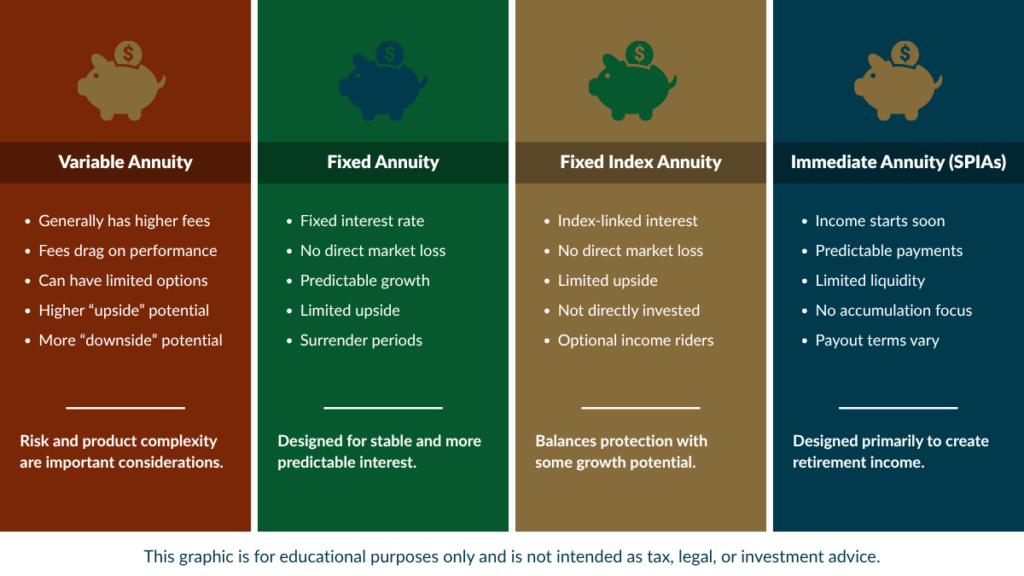
The word “annuity” covers several types of insurance contracts.
Some are designed around a stated interest rate. Others create immediate income. Variable annuities may include market-based investment options, additional fees and exposure to market losses.
Fixed indexed annuities work differently. Interest may be credited in part according to the performance of an external market index, subject to the contract’s caps, participation rates, spreads and other terms. The contract owner does not invest directly in the index.
Some are designed more for accumulation, while others place greater emphasis on future income. Withdrawal provisions, surrender periods and optional riders can also vary considerably.
Because the contracts differ, broad statements about annuities are rarely very useful. The specific contract and the purpose it is intended to serve both matter.
Opinions and Products Both Change
We understand why some people have concerns about annuities in retirement. Certain products sold in the past were expensive, restrictive or difficult to understand. Especially during the long period of low interest rates, many contracts also offered features that were not especially compelling.
But interest rates have changed, and products have continued to evolve, yet the general opinions on annuities remain the same despite possibly being appropriate for a wide range of people.
That does not make every annuity appropriate. It simply means today’s contracts should be reviewed on their current terms rather than dismissed based entirely on an older experience.
Start With the Purpose
An annuity is not a retirement plan on its own. It is one possible component of a broader plan, and its usefulness depends on the job assigned to it.
Before considering any product, we first need to understand what the money is intended to accomplish. Does it need to remain liquid? Is it intended to provide income later? Is the primary concern market exposure, growth potential, stability or leaving assets to family?
Different goals may point toward different solutions. Starting with the need makes it easier to determine whether an annuity belongs in the conversation at all.
Retirement Money May Have Several Jobs
Retirees often want their savings to provide growth, dependable income, access to money and some protection from market losses. Those are all reasonable goals, but one account may not accomplish all of them equally well.
In our experience, it is often more practical to give different portions of retirement savings different responsibilities.
Some money may need to remain liquid. Some may stay invested for long-term growth. Another portion may be positioned to provide greater stability or more predictable income.
This is why we regularly discuss the difference between having retirement assets and having a retirement income plan. An account balance may look reassuring, but it does not explain how income will be created during a prolonged market decline or what happens if retirement lasts longer than expected.
Annuities in retirement may help address part of that need, while other assets continue serving different purposes.
Understanding the Tradeoffs
Annuities may involve surrender periods, withdrawal limitations, rider costs, reduced liquidity and limits on interest-crediting potential. Their guarantees also depend on the financial strength and claims-paying ability of the issuing insurance company.
Those provisions need to be understood before someone commits retirement assets to a contract.
At the same time, tradeoffs exist in nearly every financial decision. Market investments may offer stronger growth potential but expose the account to losses. Cash provides liquidity and stability but may lose purchasing power over time.
The question is not whether a financial tool has limitations. The question is whether its benefits are useful enough to justify those limitations within a particular retirement plan.
Taking Another Look
The bond traders of the early 1980s did not purchase long-term Treasuries because bonds were always better than stocks. They purchased them because the terms available at that time were worth considering. That is the connection we find useful when discussing annuities.
Interest rates change, product designs change and income features change. A product that was not especially compelling ten years ago may look different today. That does not mean everyone should own an annuity. It simply means an old opinion should not make a current decision without first reviewing what has changed.
We believe annuities in retirement should be evaluated for what they are: insurance contracts designed to perform specific functions, with both benefits and limitations. When a contract fits the need, it may serve a useful role alongside the other parts of a retirement plan.
Source: Kiplinger